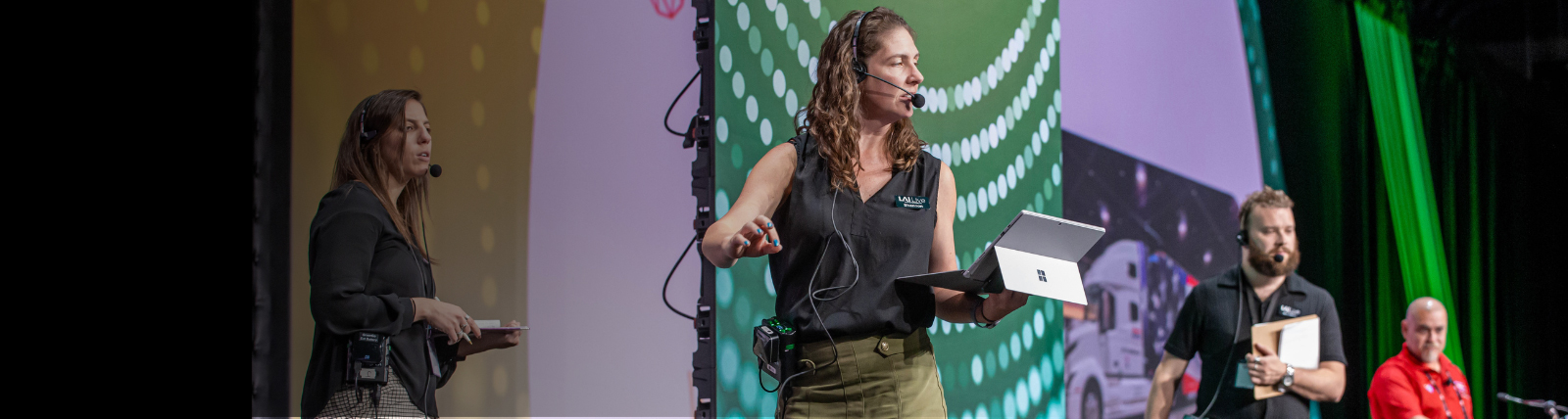
To hire a professional event production team, start by defining your event goals, budget, audience, and production needs. Research companies with experience producing similar events, review their previous work, and schedule a consultation to discuss your vision. Before choosing a partner, compare proposals, clarify responsibilities, and make sure the team can manage your event from planning through onsite execution.
The right production partner should understand what you want your event to accomplish and have the experience, resources, and team to bring it to life.
In This Blog, You’ll Learn:
- What a professional event production team does
- How to determine which production services your event needs
- What to look for when choosing an event production company
- Questions to ask before hiring a production team
- What to expect throughout the event production process
What Does a Professional Event Production Team Do?
A professional event production team manages the creative, technical, and logistical elements that bring an event to life. Depending on your needs, this can include event design, stage production, audiovisual coordination, content development, rehearsals, and onsite management.
It’s important to understand the difference between event planning, audiovisual (AV) support, and full-service event production.
Event planners typically focus on organizing the event, including schedules, registration, vendors, and attendee logistics. AV providers supply and operate technical equipment, such as microphones, lighting, screens, and sound systems.
A full-service event production company takes a broader approach, bringing these elements together to create a cohesive event experience. If you’re organizing a corporate conference with multiple speakers, branded stage design, video content, and a complex program, a production partner can help coordinate the entire experience.
Learn more about the difference between an event production company and AV support.
How Do I Determine What Event Production Services I Need?
Before reaching out to production companies, take some time to outline your event’s requirements.
You don’t need to have every detail figured out. In fact, an experienced production team can help you make decisions about the creative and technical elements of your event.
However, having a general understanding of your goals and requirements will make those initial conversations more productive.
Start by identifying:
- Event goals: What do you want attendees to learn, experience, or take away? Event consulting services can help you clarify your objectives and shape your event strategy.
- Audience: How many people will attend, and will they participate in person, virtually, or both? Consider how to understand your audience and create an experience that meets their needs.
- Event format: Are you planning a conference, leadership meeting, awards ceremony, product launch, or another type of event?
- Venue and dates: Have you secured a location, and are there any scheduling or venue restrictions?
- Budget: What resources are available for production, and where are your priorities?
- Production needs: Will you need stage design, audiovisual support, event branding, video content, or onsite management? Explore full-service event management and production to better understand the services available.
Most importantly, consider what you want your event to accomplish rather than starting with a list of equipment.
For example, if your goal is to create an engaging executive presentation, a production partner can help determine the right stage layout, visuals, lighting, and program flow to support that experience.
What Should You Look for in an Event Production Company?
Once you’ve outlined your event needs, the next step is finding a production company with the experience and capabilities to support them.
Start by reviewing the company’s portfolio. Look for projects that are similar to yours in format, audience size, and production complexity.
A company that regularly produces corporate conferences, for example, may be better equipped to manage a multi-day leadership summit than a team whose experience is primarily limited to smaller social events.
As you evaluate potential partners, consider their:
- Relevant experience: Have they produced events similar to yours?
- Portfolio and references: Can they demonstrate their work and provide examples of successful projects?
- Production capabilities: Can they support your creative, technical, and logistical requirements?
- Team structure: Who will be responsible for managing your event?
- Communication: Do they clearly explain their process, responsibilities, and expectations?
Explore LAI Live’s projects and shows to see examples of professional event production across different formats and industries.
What Questions Should You Ask Before Hiring an Event Production Team?
An initial consultation is an opportunity to understand how a production company approaches its work and whether its team is a good fit for your event.
Consider asking the following questions:
- Who will be our primary point of contact throughout the production process?
- Have you produced events similar to ours?
- Which services does your team handle directly, and which require outside vendors?
- How do you coordinate with venues, AV providers, and other event partners?
- How do you manage unexpected changes or technical issues during an event?
- What information and materials will you need from our team?
- How do you manage production schedules, approvals, and deadlines?
Pay attention to how thoroughly the team answers your questions.
A qualified production partner should be able to explain its process, identify potential challenges, and help you understand what will be required to execute your event successfully.
What Happens After You Hire an Event Production Company?
Once you’ve hired an event production company, your producer will work alongside your team to manage the creative, technical, and logistical aspects of your event.
Here’s what you can expect throughout the process:
1. Initial Planning and Strategy
Your production team will start by discussing your event goals, audience, budget, and overall vision. From there, they’ll establish production timelines, responsibilities, and key deliverables.
2. Creative Development and Pre-Production
Your team will begin coordinating event design, audiovisual requirements, stage production, graphics, and program content. This stage also includes working with vendors, developing the run of show, and preparing for rehearsals.
3. Onsite Production and Execution
During the event, your production team will coordinate technical crews, manage rehearsals, oversee stage production, and keep the program running according to schedule.
Throughout the process, your producer serves as a central point of contact for production-related decisions, allowing your internal team to focus on attendees, speakers, and other event responsibilities.
Learn more about what it’s like to work with LAI Live.
How Can LAI Live Help Produce Your Next Event?
Hiring a professional event production team starts with finding a partner who understands your goals and has the experience to execute your vision.
At LAI Live, we work with corporations, associations, nonprofits, and other organizations to produce events that bring together strategy, creative development, technical production, and onsite execution.
Whether you’re organizing a corporate conference, executive meeting, awards ceremony, or large-scale event, our team can help you determine the production services and resources needed to bring it all together.
Ready to find the right production approach for your next event?
Connect with the LAI Live team to discuss your event goals, production needs, and how we can help bring your vision to life.